
Earth chakras & sacred sites
Learn about the Earth chakras, ley lines, and sacred landscapes surrounding Glastonbury, from the Tor to the wider Somerset Levels.

Welcome to the Heart Chakra of the Earth
Little Hive is in the heart of one of the world’s most sacred landscapes. Glastonbury, the heart chakra of the Earth, also known as the Isle of Avalon, is where you can hear the ancient myths and the earth spirit.
The Tor, Chalice Well, the sacred White springs, Red Spring, the Abby, ancient mounds, Gog and Magog Oaks, and so much more all invite you to walk, breathe, and feel the living energy of the land. Follow the ley lines, find the energy portals, listen to the myths and mysteries. Most of all, we encourage you to follow your intuition and explore the unknown.
The Earth herself has a living energy system, a chakra system, just like our own bodies. She has a heart, a will, vitality, and centres of communication. Each chakra contributes to the health and flow of the planet; they work together, a web of life, energy, and balance that sustains the world, and we are called to participate in this unifying relationship, to commune with the Earth and share our gifts with the grid, to bring our pure hearts, listen, and respond to the call.
The Earth’s seven major chakra sacred sites are: Base chakra: Mount Shasta, USA, Sacral chakra: Lake Titicaca, Peru, Solar plexus chakra: Uluru/Kata Tjuta, Australia, Heart chakra: Glastonbury, UK, Throat chakra: the Great Pyramids, Egypt, Third eye chakra: Shaftesbury/Glastonbury, Crown chakra: Mount Kailash, Tibet. You can read more about this on Louise’s website and in her second book, Earth Chakra Shaman.
Shaftesbury is the Earth’s third-eye chakra (more about that further down and on Lou’s website ). Shaftesbury is a quaint town on potent land; The Abbey ruins and panoramic views across Wiltshire, Somerset, and Dorset will all connect to Glastonbury’s heart energy. Meditate and connect with the living spirit of the land.
Below is an introduction to many of the sacred sites in and around Glastonbury and further afield…
Chalice Well & Gardens

Chalice Well is one of Glastonbury’s most ancient and potent sacred sites, a place that has drawn pilgrims, seekers, and those sensitive to the Earth’s energies. At the heart of the garden is the Red Spring, a chalybeate spring rich in iron oxide, which gives the water its distinctive red hue. Its origin is deeply mysterious, and we do not truly know how deep it is or how far it goes.
The gardens themselves are a sanctuary of stillness, meditation, and contemplation; a space where the feminine energy of the land is palpable in every flower, tree, and pathway.
Wellesley Tudor Pole & the Silence for Reflection
Wellesley Tudor Pole (1884–1968) was a mystic, spiritualist, and one of Glastonbury’s key modern spiritual figures. Deeply attuned to sacred sites, ley lines, and the energies of the land, he spent much of his life working to bridge spiritual insight and practical action.
Sir George Trevelyan called Wellesley Tudor Pole (WTP) “undoubtedly one of the great seers and adepts of this epoch.” WTP first visited Glastonbury in 1902 and felt an immediate affinity with Chalice Well, the ancient red spring at the foot of the Tor.
In 1906, aged 23, he discovered a sapphire-blue bowl buried in the ground at Glastonbury, which guided him on a lifelong quest to uncover evidence of the original teachings of Jesus. He believed that Glastonbury was a central spiritual hub for Britain and worked as early as 1903 to link Avalon (Glastonbury), Iona in Scotland, and Devenish Island in Northern Ireland as three powerful, interconnected spiritual points.
WTP’s work was about awakening these three sites in preparation for the new era of the Age of Aquarius. He concluded that Glastonbury itself would not have fully awakened without Chalice Well being brought back to life and that the restoration of Iona, energetically linked to Glastonbury, was essential for the future destiny of Britain.
During the First World War, WTP became aware of the profound need for collective reflection and honouring those lost in the conflict. In 1916, inspired by visions and his own deep meditation, Tudor Pole’s spiritual insight emphasised that silence itself is a form of active prayer, a means of connecting with the unseen, the Earth.
He proposed to the King and Prime Minister a silent minute of prayer for freedom, at 9pm each evening during the striking of Big Ben, a practice that would later become the two-minute silence observed on Armistice Day.
Tudor Pole’s teaching that silence is sacred, healing, and connecting continues… Walking in the gardens, sitting by the wellhead, or simply pausing in the presence of the Red Spring, the WTP vision for collective reflection and gentle Earth healing is all around.
“There is no power on earth that can withstand the united cooperation on spiritual levels of men and women of goodwill everywhere. It is for this reason that the continued and widespread observance of the Silent Minute is of such vital importance in the interests of human welfare.” – WTP
Glastonbury Tor

Glastonbury Tor rises high above the town, a beacon of the heart chakra that calls us all from our sleep! The Tor is an iconic place on the planet—where myths, magic, history, and earth energy meet, where ley lines converge and move in a subtle dance. The Michael Line passes through here, running from St Michael’s Mount in Cornwall, through Glastonbury Tor, and onward to Norfolk. Alongside it, the Mary (or St Bridget) Line flows. It is only at the Tor that these lines truly meet, their energies in a divine union. In the Earth Chakra work, the energy flow is called the Rainbow Serpent.
There are two ways up the Tor: follow the pathway from Well House Lane and walk past the Blossom Circle, or take a wonderful walk up Bushy Coombe, Chalice Hill, and then around the back and up the steps.
If you come from the back of the Tor, from Chalice Hill, you might discover Avalon Orchard, a quiet, tucked-away spot with a fire hidden amongst the apple trees. The Isle of Avalon is “the Isle of Apples.”
For some, there is a call to follow the labyrinth that runs around the sides of the hill. Maybe you will discover the egg stone (Tor Burr) tucked behind two hawthorns? These rounded stones aren’t just ordinary rocks; their shapes and textures have fascinated people for centuries (there is one in the Abbey if you want to get a closer look; don’t sit on it unless you are looking to get pregnant!). Egg stones are like dragon eggs, and I’m sure they are; they were created by lightning!
At the top of the Tor stands the tower of St. Michael, which was once a wooden church but was destroyed in 1275 by an earthquake, and in the 14th century, the Church of St. Michael was built on the site; this is what remains.
The views are amazing. Close your eyes, and you might feel the depth of another world below your feet. The Tor is steeped in legend and folklore. What’s within the Tor? Sleeping dragons? A network of caves? The gateway to Annwn? The entrance to the realm of the fairies? I once saw the rainbow serpent wrapping herself all around the Tor, and it was then I knew the Earth Grid to be alive, and the rainbow serpent fully at work.
The myths of the Tor run deep; go sit, feel, and listen for yourself.
The Abbey

Glastonbury Abbey is a legendary place in Glastonbury. It is said to be the earliest Christian foundation in Britain, thanks to Joseph of Arimathea. I strongly recommend simply being here, spending hours on the grounds, walking through the ruins.
There’s a deep sense of peace and sacredness across its 36 acres of grounds. You can wander quietly, listen to the whispers of those who walked before us. As you explore, you’ll discover quiet corners, a wildlife sanctuary, the amazing fish, views of the Tor, a Medieval Kitchen Garden, and the egg stone! (I shared about the egg stone in the Tor section).
The Abbey was first founded in the 8th century and grew in importance through the 10th century. It suffered a devastating fire in 1184, but rose again. From the 12th century, Glastonbury became entwined with the legend of King Arthur, promoted by medieval monks (some would argue it was a bit of a money spinner). But, like much of Glastonbury, truth, history, and myth seem to weave together into one mystical story. By the 14th century, it had become one of the richest and most powerful monasteries in England. Glastonbury was the wealthiest monastery at the end of the Saxon period, second only to Westminster Abbey at the close of the Middle Ages.
The museum is wonderful; there’s a lovely new café, and The Abbey hosts some amazing events, so keep an eye out for what’s happening when you visit.
Wearyall Hill

Wearyall Hill sits just beyond Glastonbury Tor and holds a very special place in the story of Avalon. When Joseph of Arimathea arrived in Britain, legend says he landed on the Isle of Avalon (Glastonbury) and climbed Wearyall Hill. Exhausted, he thrust his staff into the ground and rested. By morning, the staff had taken root and grown into a miraculous thorn tree, which bloomed twice a year.
The Holy Thorn also has royal connections. In a tradition dating back nearly a century, a sprig of Holy Thorn is taken from a specimen growing in the Abbey and sent to Buckingham Palace to be placed on the Christmas table of the monarch. For us, many magical happenings occur on the hill. Go watch the sunset in mid-summer, watch the way the light moves across the lands, observe the stars… this is a gateway of wisdom, a place for the seers.
The White Spring

One of the great mysteries of Avalon is that two very different healing springs rise just a few feet apart beneath Glastonbury Tor. The White Spring comes straight from the body of the Tor itself, while the red springs come from deep in the earth. Honouring the waters here in Glastonbury is an essential step to entering Avalon.
A temple has been created in the old Victorian Well House, tucked in beneath the Tor, in honour of the spirit of the white spring. Inside, the space is dark and candlelit with alters and a series of pools that have been created with sacred geometry to honour the water flow. This is a living temple, where people come to pray, sing, and dip into the cold waters for healing. There is always a great ambience, people gathering inside and out.
The White Spring is cared for by its guardians and companions, people who give their time freely. There is no expectation of donation, but we always give a little to support the continuous upkeep of the temple and candles.
Beyond the town, the ancient landscapes of Wiltshire and Oxfordshire, from the Uffington White Horse and Wayland’s Smithy to Avebury, Silbury Hill, and Stonehenge, are all interconnected in this earthly web.
White Horse Hill & Dragon Hill

Approx 2 hours from Glastonbury: White Horse Hill, in the rolling chalk downs of Oxfordshire, is one of England’s most remarkable ancient landscapes. At its heart is the Uffington White Horse, a chalk figure cut into the hillside that stretches over 100 metres from head to tail. This is not a recent artwork; archaeological dating shows this hill figure was created in the late Bronze Age or early Iron Age, around 3,000 years ago, long before written history here.
The White Horse is unique and very different from later white horses carved into hills elsewhere in the country; it’s been maintained, and there is something quite profound about these lands.
Just below the White Horse sits Dragon Hill, a small, natural chalk mound with a strangely flat top. Local tradition links this place to the legend of St George and the Dragon, and on the very summit is a bare patch of chalk where, folklore says, the dragon’s blood was spilled and the grass will never grow.
The Rollright Stones – Whispering Stones of Time

Around 2.5 hours from Glastonbury – on the edge of the Oxfordshire-Warwickshire border, the Rollright Stones are a remarkable collection of Neolithic and Bronze Age monuments, another place where history, myth, and the living land seem to merge. Here, there is a charge – the stones remember thousands of years of human presence. They are truly alive.
The site is made up of three main elements: the King’s Men circle, the King Stone, and the Whispering Knights. The King’s Men is a stone circle, dating back around 4,000 years, standing as a quiet testament to the ceremonial life of ancient communities. Walking among the stones, you sense their deliberate placement, aligned with the landscape, the sky, and perhaps the stars.
The King Stone, a solitary monolith just a short walk away, is said to represent the king himself, standing watch over his people for millennia. Folklore tells that the king and his men were turned to stone by a witch, the Whispering Queen, and the remaining stones echo that story, giving the site its mystical name.
The Whispering Knights, a small dolmen just a little further along the hill, are thought to have been a burial chamber or ritual site. Here, bring an offering, and listen to the whisperers…
The Rollright Stones are living landmarks; it’s often quiet here, so you can walk among them and feel the layers of energy and intention embedded in the land.
Stonehenge
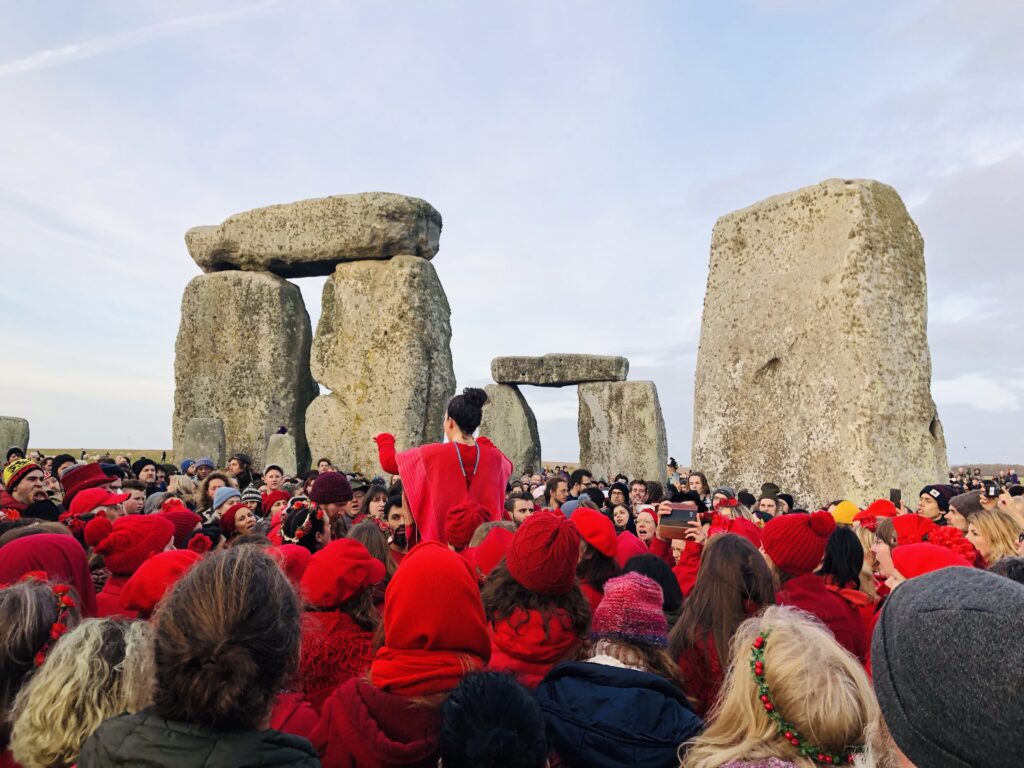
Stonehenge needs little introduction; its massive stones rising from the Wiltshire plain have captivated people for thousands of years. If you have driven down the A303, you will have seen them from a distance. We are convinced, as a family, that they move. We often note, “The stones feel close today,” or “The stones seem far away today.”
Built between 3000 and 2000 BCE, the circle is aligned with the solstices, reminding us of the deep astronomical knowledge of its builders and the sweet unknowns of these times—like, really, how was it built? Moving stones from Wales. Was it giants?
Walking around Stonehenge today, even without touching the stones, you can feel their presence. And the land is vast; from the sky, we can really see how far the henge goes, and it extends far beyond the stone circle. The rhythm of the landscape, the alignment with sky and sun – this feels not just like a place of ceremony but of some deeper connection, where human devotion meets the pulse of the Earth itself, and the beings in the sky! (This area is well known for crop circles – but that’s a whole other rabbit hole we can’t go down here!)
Want to touch the stones? Every year we gather at the solstice; the fence comes down for dancing and singing up the sunrise of a new season.
Nearby, sites like Durrington Walls and Woodhenge add to the sense of a sacred landscape woven with intention, movement, and community. Visiting Stonehenge is not just about seeing stones; it is about feeling the weight of centuries of human imagination and the quiet majesty of the land.
Avebury Stone Circle

Avebury is the largest stone circle in Europe, part of the Avebury World Heritage Site along with Silbury Hill and West Kennet Avenue. Visit all three of these places, and you will begin to feel the deep reverence of the land.
Avebury village and stone circle: Unlike Stonehenge, you can walk among the stones freely, very immersive, the stones are ancestors, put your ear to them and sit a while, you may hear their stories, or for us, their music. Sing to them – they love a soul song.
As you wander the circle, through the village, go find the magic tree… take an organic offering, a flower, and place it on the roots, and make a wish – remember your wishes for others come back tenfold.
West Kennet Avenue: An avenue of standing stones connecting Avebury to nearby sites; great for walking meditation.
Silbury Hill: An ancient man-made mound; access to the top is restricted, but paths around it provide perspective.
West Kennet Avenue

West Kennet Avenue stretches like a ribbon of standing stones from Avebury toward the surrounding hills. Originally, it may have guided processions, ceremonies, or seasonal rituals.
Walking this avenue today is a meditative journey, allowing you to connect with the energy of those who came before, the rhythm of the stones, the natural curves of the land, and the quiet presence of the ancestors.
You can sense how the avenue links the circles, mounds, and surrounding landscape, creating a living connection between places of ritual, reflection, and human intention. Every step along West Kennet Avenue invites you to feel the layers of history and the enduring pulse of the land.
Note: If you are called to the waters – The Swallowhead Springs are near East Kennet village – take your offerings. Go lightly.
Silbury Hill
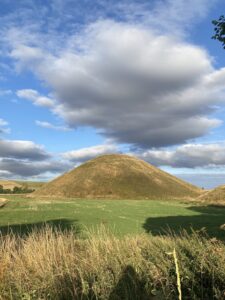
Silbury Hill is an ancient man-made mound, the largest in Europe. Its size and presence are truly awe-inspiring. You can’t climb to the top these days, but walking around it, you can feel the energy it radiates.
It was built over 4,500 years ago, and its purpose remains a mystery: ritual, ceremony, or a statement of devotion, or an alien landing station? The hill seems to hold time itself, quiet and eternal – it’s in the quietness that something else is heard.
Other nearby sites: Windmill Hill (a prehistoric ritual site) and Beckhampton Long Barrow (a burial mound).
Shaftesbury – The Third-Eye Chakra
Shaftesbury is a hilltop town with historical and mystical associations. It is said to be the third-eye chakra of the Earth, aligned with Glastonbury’s heart chakra. (More about the third-eye chakra, how it moved, and why it is conjunct with Glastonbury for the Age of Aquarius here and in Louise’s 2nd book Earth Chakra Shaman is avaible on Audible, Paperback and Kindle).
The motto “when the abbess of Shaftesbury marries the abbot of Glastonbury, there will be harmony across the land.” This has a multilayered meaning – that Robert Coon – Brinher of the Earth Chakra system speaks of
The abbey ruins, founded by King Alfred the Great in 888, were led by his daughter, Æthelgifu, the first female abbess in England. Under her guidance, the abbey grew into one of the wealthiest and most influential religious centres of the time, a place of learning, devotion, and sacred presence.
There is a cross in the abbey ruins that was once filled with alabaster – many links to the throat chakra of the earth here – Egypt – You can read more about this in Louise’s book – Earth Chakra Shaman, and hear how this potent place calls for gentle earth activations and holds ancient mysteries, linking King Alfred, King Arthur, Archangel Gabriel, and Jesus.
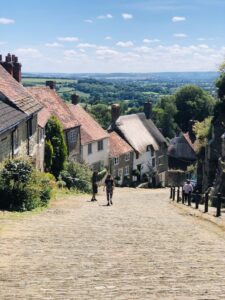
Head to Gold Hill: Famous steep cobbled street; great for photography. Also once used in the 1980s Hovis advert (for those old enough to remember). There are Hillside walks: Ridgeways and footpaths offer panoramic views, hidden sacred wells if you feel called to adventure further into the lands. Outside the abbey is a sundial where you can see across Wiltshire, Somerset, and Dorset, feeling the sweep of the land and the wider rhythm of this sacred region. The town, the abbey, and the surrounding hills invite reflection, connection, and a sense of harmony with the Earth.

Earth Chakra Sharman by Louise Carron Harris
It is one thing to look back and connect the dots of your life, to see meaning in your past experiences, and to recognise that being here is no coincidence, that it was all in the divine plan from the start. But following a call to go places you’ve never been—not knowing why, just knowing you have to go—that takes the kind of courage Lou didn’t know she had.